
Table of Contents
Browse the Guide
1. Why Delhi’s monsoon is hard onn buildings?
2. The Pre-Monsoon Window: When to Act?
3. What to Waterproof Before Monsoon — Surface by Surface?
4. Waterproofing Costs: What-to-Budget?
5. Waterproofing vs. Waterproof Paint: What’s the Difference?
6. Can Waterproofing and Painting Be Done Together?
7. How to Evaluate a Waterproofing Contractor?
8. Book Pre-Monsoon Waterproofing in Delhi NCR
9. Get waterproofing estimate
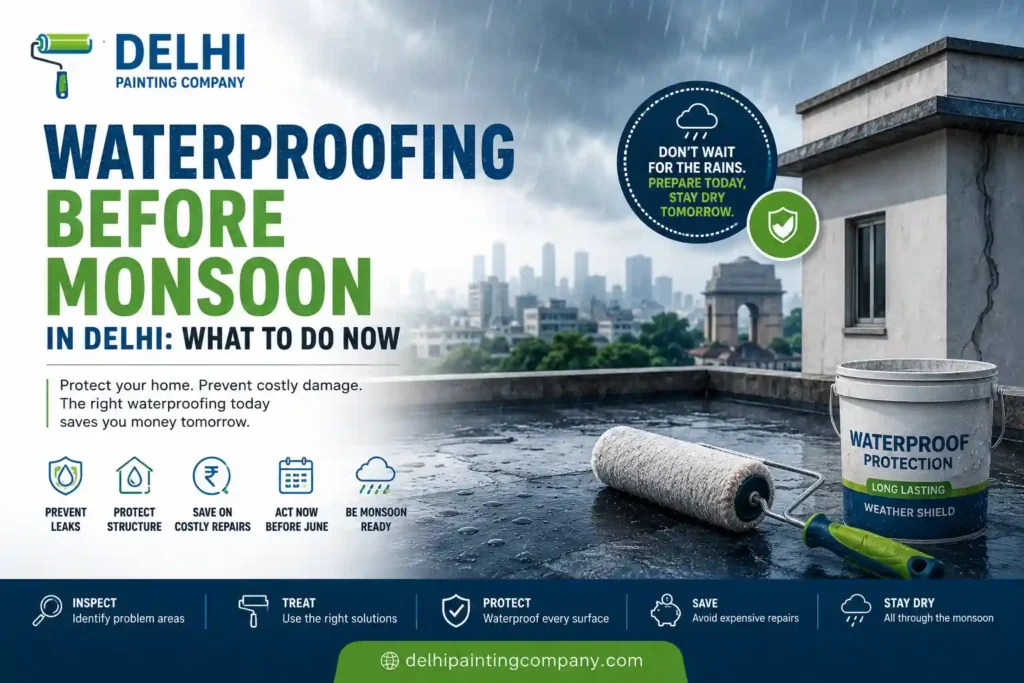
Delhi’s monsoon arrives around the last week of June — and it doesn’t give you much warning. One heavy downpour is usually all it takes to expose every crack, weak joint, and neglected surface on your building. Roof leaks, seeping walls, damp ceilings — most of these problems don’t appear during the rain. They appear because nothing was done before it.
Pre-monsoon waterproofing is the one maintenance job that actually saves money. Fixing active seepage mid-monsoon costs two to three times more than treating the same surface in May or early June — and the results are worse because wet surfaces don’t bond well with waterproofing compounds.
This guide covers what to waterproof, when to do it, what it costs, and the right order of work so nothing gets missed.
Need Waterproofing Services? Get a Quick Estimate
Tell us your waterproofing requirement and our team will contact you shortly for a free site visit.
- ✔ Free site inspection
- ✔ No hidden charges
- ✔ Quick Response
Trusted by Delhi Homeowners
✔ Experienced professional painters
✔ Premium materials & clean finish
✔ On-time completion guarantee
 200+ homes waterproofed across Delhi NCR
Need Waterproofing Services? Get a Quick Estimate
Tell us your waterproofing requirement and our team will contact you shortly for a free site visit.
✔ Free site inspection ✔ No hidden charges
✔ Quick Response
Why Delhi's Monsoon Is Hard on Buildings
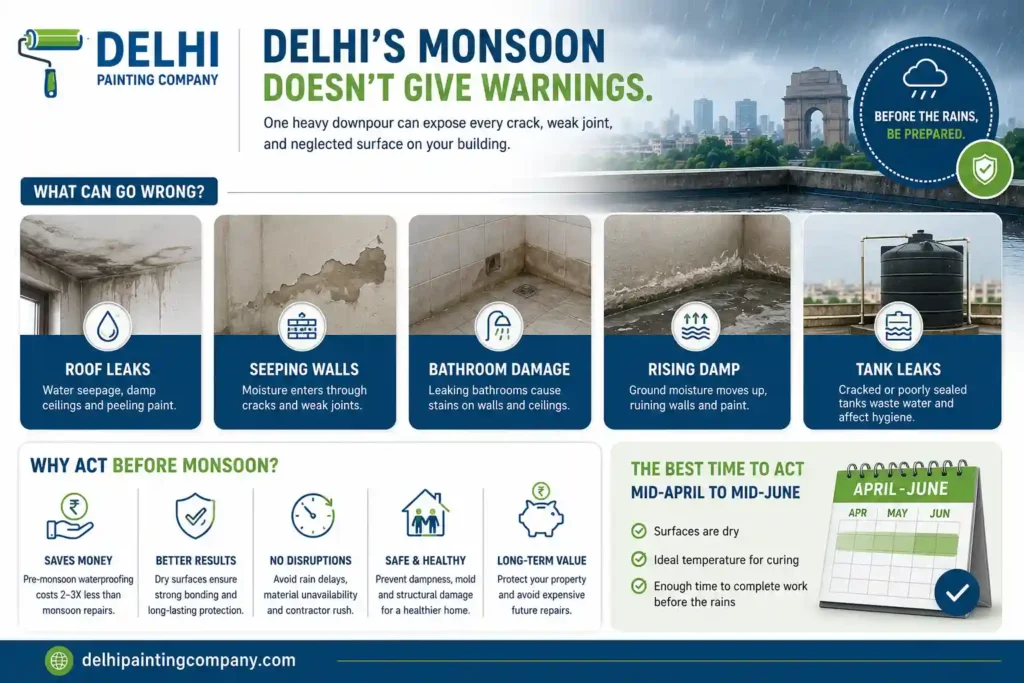
Delhi receives roughly 650–800 mm of rainfall annually, with nearly 80% of it compressed into June, July, and August. The city’s built environment — a mix of old DDA flats, builder floors, independent houses, and newer society apartments — deals with this concentrated rainfall in very different ways.
Older constructions in areas like Chittaranjan Park, Greater Kailash, and Malviya Nagar often have flat or low-slope roofs with ageing waterproofing membranes. Builder floors and independent houses in Vasant Kunj and Chhatarpur commonly deal with terrace seepage and compound wall dampness. Even relatively newer constructions in Saket and Hauz Khas are not immune — cracked expansion joints and blocked drainage channels create pooling that finds its way in.
The problem is rarely the rain itself. It’s the accumulated neglect of surfaces that cracked, shifted, or degraded over the preceding year and were never treated.
The Pre-Monsoon Window: When to Act
The ideal window for waterproofing in Delhi is mid-April to mid-June. Surfaces are dry, ambient temperatures are warm enough for curing, and you have enough lead time to complete the work properly before the rains begin.
What happens if you wait:
- Post-June work is unpredictable — rain interrupts curing, contractors are unavailable, and prices go up
- Mid-monsoon patches are temporary fixes at best; water intrusion continues beneath the repair
- Damage compounds — a seeping roof that’s ignored for one season often requires full slab-level treatment the next year
Booking in May gives you the best combination of dry conditions, material availability, and contractor bandwidth.
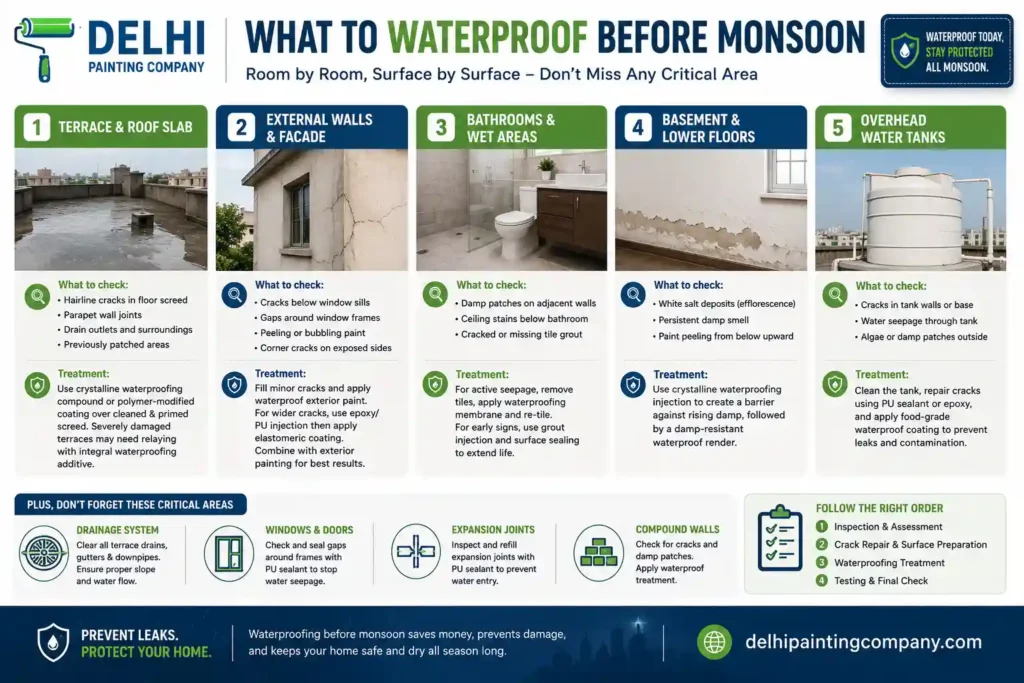
What to Waterproof Before Monsoon — Room by Room, Surface by Surface
1. Terrace and Roof Slab
This is the highest-priority surface. A flat Delhi terrace accumulates water during heavy rain, and any crack in the screed, parapet joint, or drainage mouth becomes a direct entry point.
What to check:
- Hairline cracks in the floor screed
- Parapet wall joints (where the wall meets the slab — a very common failure point)
- Drain outlets and their surrounding areas
- Any previously patched sections that may have debonded
Treatment: Depending on the condition, the right solution is either a crystalline waterproofing compound (for active micro-cracks) or a polymer-modified coating system over cleaned and primed screed. Badly deteriorated terraces sometimes need the screed broken and relaid with an integral waterproofing additive.
2. External Walls and Facade
Delhi’s exterior walls take the full force of wind-driven rain. Cracks in plaster, gaps around window frames, and failing paint film are all entry points.
What to check:
- Horizontal cracks below window sills (water collects there and seeps in)
- Gaps between window frames and the surrounding wall
- Peeling or bubbling exterior paint — this usually indicates moisture already behind the surface
- Cracks at corners, especially on the weather-exposed side of the building
Treatment: Minor cracks get filled with polymer-modified putty or crack filler before a waterproof exterior paint is applied. Wider or structural cracks require crack-widening, epoxy or PU injection, and then a textured elastomeric coating. If you’re planning exterior house painting this season anyway, combining it with facade waterproofing treatment makes practical and economic sense — one mobilisation, one scaffolding setup.
3. Bathrooms and Wet Areas
Bathroom waterproofing failures show up as dampness on the wall of the room next to the bathroom, or on the ceiling of the floor below. By the time you see the stain, water has already been travelling through the slab for some time.
What to check:
- Damp patches on shared bathroom walls or adjacent room walls
- Staining or peeling paint on the ceiling below an upper-floor bathroom
- Cracked or broken tile grout (the most common entry point)
Treatment: For active seepage, the floor tiles typically need to be broken, the surface treated with a cementitious or polyurethane waterproofing membrane, and then retiled. For preventive treatment on bathrooms showing early signs, a grout injection with hydrophobic material and surface sealing can extend life significantly.
4. Basement and Lower Floors
Properties in older Delhi neighbourhoods — particularly ground-floor flats and independent houses in Greater Kailash 2 or Chhatarpur — often deal with rising damp. This is groundwater migrating upward through the plinth and lower wall courses.
What to check:
- White salt deposits (efflorescence) on lower wall areas
- Persistent damp smell in ground-floor rooms
- Paint peeling from below upward on ground-floor walls
Treatment: Rising damp needs crystalline waterproofing treatment — chemical injection into the wall to create a barrier — combined with a surface application of a damp-resistant render. Standard waterproof paint applied over a rising damp problem will fail within weeks.
5. Overhead Water Tanks
Overhead tanks are frequently overlooked. A cracked or poorly sealed tank allows algae growth and contamination, and leaks at the base can cause sustained water damage to the roof slab below.
Treatment: Tank interior coating with a food-safe, water-based polyurethane sealant — after draining, cleaning, and crack treatment. This is typically a half-day job and is worth doing every three to four years.
Waterproofing Costs: What-to-Budget
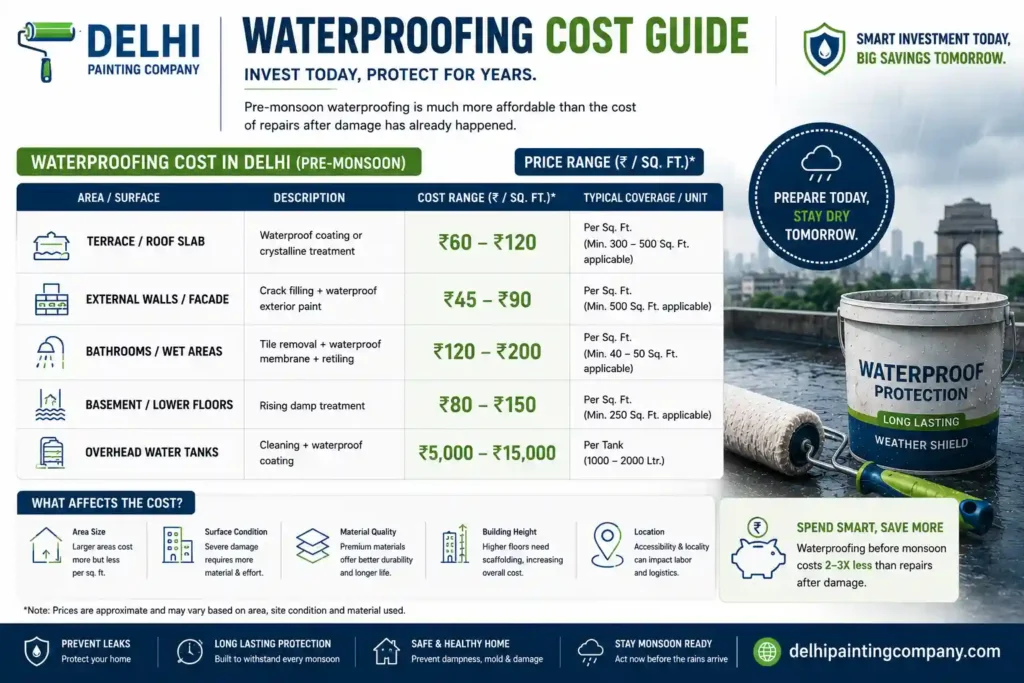
Cost depends heavily on the surface, its current condition, and the treatment required. Here are indicative ranges for Delhi NCR in 2026:
| Surface | Treatment Type | Approximate Cost |
|---|---|---|
| Terrace / Roof Slab | Polymer Coating System | ₹60–110 per sq ft |
| Terrace / Roof Slab | Full Membrane + Screed | ₹120–200 per sq ft |
| External Walls | Waterproof Exterior Paint | ₹30–55 per sq ft |
| External Walls | Crack Filling + Elastomeric Coat | ₹50–90 per sq ft |
| Bathroom (Floor + Walls) | Membrane with Tile Breaking | ₹150–250 per sq ft |
| Basement / Rising Damp | Chemical Injection + Render | ₹80–140 per sq ft |
| Overhead Tank (Interior) | Polyurethane Coating | ₹4,000–8,000 per tank |
For a detailed cost breakdown with product-wise pricing, see our full waterproofing cost guide for Delhi 2026.
Waterproofing vs. Waterproof Paint: What's the Difference?
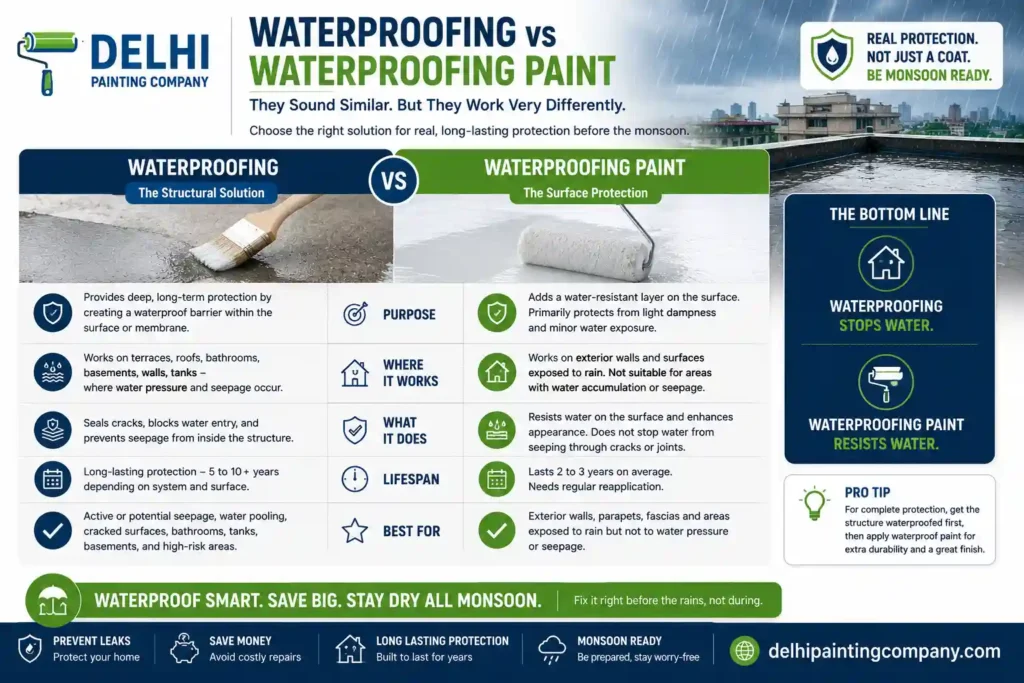
This is a question we get often. A waterproof exterior paint (like Dulux Weathershield or Asian Paints Apex Ultima) provides surface-level water resistance — it keeps light rain from penetrating the paint film. It’s not the same as structural waterproofing.
Waterproofing addresses the substrate — the plaster, screed, slab, or masonry beneath the surface. It uses membranes, crystalline compounds, or injection systems that block water at depth, not just at the surface.
For most Delhi homes doing pre-monsoon preparation:
- If the issue is surface-level (faded or cracked paint, minor dampness): waterproof exterior paint is the right answer
- If the issue involves active seepage, staining on internal walls, or visible water ingress: proper structural waterproofing is needed first, paint after
Applying waterproof paint over an active seepage problem is a cosmetic fix. It will fail before the monsoon is over.
Can Waterproofing and Painting Be Done Together?
Yes — and combining them is usually the smarter approach. If you’re planning to repaint your exterior or interior this year, scheduling waterproofing treatment first means:
- Surfaces are properly prepared before paint is applied
- One contractor mobilisation instead of two
- Paint adheres better to treated, stable surfaces
- You’re not repainting over a surface that will fail in the next monsoon
For homeowners in South Delhi who are considering both, our exterior house painting service and waterproofing service are typically planned and executed together. You can also check house painting costs in Delhi to understand the full combined budget before calling.
How to Evaluate a Waterproofing Contractor
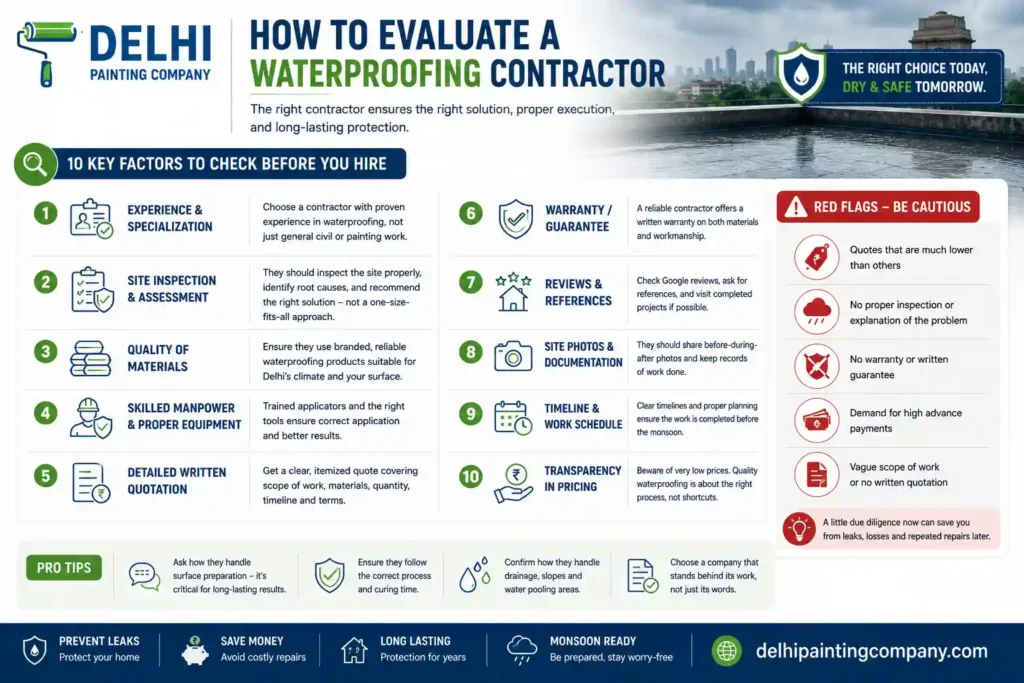
Waterproofing is an area where poor workmanship creates immediate, visible, and expensive failures. A few things to check before hiring:
1. Do they assess before quoting? A contractor who quotes over the phone without visiting the site is guessing. Surface condition, crack type, moisture reading, and drainage situation all affect what treatment is appropriate. A site visit is non-negotiable.
2. Do they specify the product? Ask for the brand and product name of the waterproofing compound being used. Reputable contractors specify Dr. Fixit, Pidilite, Fosroc, or MYK Laticrete products and can show you the datasheet. Vague answers like “good quality material” are a red flag.
3. What warranty do they offer? Most professional waterproofing jobs carry a 3–5 year warranty on the treatment. Confirm this in writing before work begins.
4. Do they do surface preparation properly? The most common cause of waterproofing failure is inadequate surface prep — painting over dirt, skipping primer, or not treating cracks before coating. Ask specifically how they handle this.
For a broader guide on what to check before hiring any contractor in Delhi, see how to choose a painter in Delhi — most of the evaluation principles apply equally to waterproofing specialists.
Book Pre-Monsoon Waterproofing in Delhi NCR

Delhi Painting Company has been handling pre-monsoon waterproofing across Delhi NCR since 2017 — terraces, bathrooms, facades, and rising damp treatment. We provide site assessments, specify products by name, and back the work with a written warranty.
If you’re in Malviya Nagar, Hauz Khas, Greater Kailash, Chittaranjan Park, or anywhere across Delhi NCR — call or WhatsApp us now to schedule a free site visit before the pre-monsoon slots fill up.
Frequently Asked Questions
Q1. How long before monsoon should I get waterproofing done?
Ideally 4–6 weeks before monsoon onset — so late April to early June for Delhi. Most waterproofing compounds need 7–14 days of dry curing time, and you’ll want a buffer in case of rain delays or rework. Waiting until June is cutting it very close.
Q2. Can waterproofing be done during monsoon?
For most systems, no. Cementitious and polymer coatings need dry surfaces to bond. Crystalline waterproofing and some polyurethane injection systems can be applied on damp (not wet) surfaces and are sometimes used for emergency mid-monsoon repairs — but results are less reliable and warranties may not apply.
Q3. My terrace was waterproofed 3 years ago and is leaking again. Why?
Waterproofing does not last forever. Typical lifespan is 5–8 years for a membrane system and 3–5 years for a coating system, depending on traffic, thermal cycling, and UV exposure. A joint or drain that was properly sealed can also re-open as the building settles. Age plus settlement is the most common cause of repeat leakage.
Q4. Is waterproofing covered under apartment society maintenance?
For society apartments, terrace waterproofing and external facade maintenance typically fall under society maintenance — but response time and quality vary enormously. For your own flat’s bathroom, internal walls, or private terrace, you are responsible. Many South Delhi society residents in Saket and Vasant Kunj arrange their own waterproofing independently because society schedules don’t align with monsoon timelines.
Q5. What is the difference between Dr. Fixit and a membrane waterproofing system?
Dr. Fixit is a brand — they make both cementitious coatings and polymer membrane systems. “Dr. Fixit” in common usage usually refers to their Pidifin or Dampguard range, which are brush-applied cementitious coatings suited for bathrooms and mild terrace dampness. A torch-applied or self-adhesive membrane is a different product category — thicker, more flexible, and suitable for terraces with heavy water load or significant cracking. The right choice depends on the surface and severity.
Q6. Does waterproofing affect interior painting?
Yes, indirectly. If you waterproof exterior walls or the terrace properly before interior painting, the interior walls dry out and paint adhesion improves significantly. Rooms that had damp-related peeling often stay stable after waterproofing is done on the external source. It’s one reason we recommend addressing waterproofing before interior house painting in buildings that have had any history of seepage.
Need Painting Estimate?
Get Free Quote